



If you’ve recently attended a conference or read articles in the social sector, you may have noticed a growing emphasis on terms like ‘evidence-backed programs,’ ‘impact evaluations,’ ‘results orientation’ and ‘data-driven decision-making.’ This reflects a gradual movement towards approaches that build accountability for end outcomes, such as outcomes-based financing (OBF), a development financing and delivery model that moves beyond counting activities and outputs to focus on measuring the real impact of a program.
This shift is driven by push and pull factors. On the push side, donor expectations are evolving toward strategic approaches and greater value for money. Similarly, government regulations are increasingly prioritising reporting on outcomes. On the pull side, OBF is enabled by advancements in technology and data and private-sector thinking.
Unlike grant funding tied to activities, OBF links a ‘meaningful’ proportion of funding to pre-agreed, measurable and verifiable outcome targets, thus using money to incentivise accountability to outcomes. For instance, instead of merely counting how many teachers are trained (‘output’), OBF ties funding to whether that training improved student learning (‘outcome’).
While OBF presents nonprofits with exciting opportunities to demonstrate impact and better serve their communities, it can be overwhelming. So, what does it mean to be truly ‘outcomes ready’? And why is this investment vital for nonprofits?
What is outcomes readiness?
Outcomes readiness refers to a nonprofit’s preparedness to participate in OBF programs. In developing the Outcomes Readiness Framework, we focused on the additional competencies required beyond an organisation’s foundational capacities. These go above and beyond business-as-usual requirements and are referred to as ‘plus-plus’ competencies.
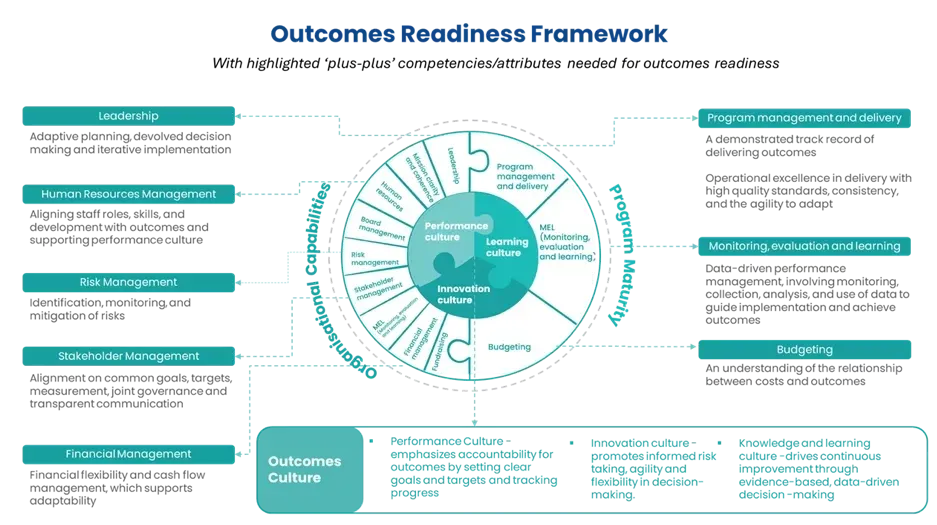
Supported by 360 ONE Foundation, the framework includes tangible and intangible components. On the intangible side and at the core is outcomes culture—a mindset centered on accountability, learning, and continuous improvement.
On the tangible side, outcomes-readiness entails two sub-components—outcomes-oriented systems and processes at the organisational level and program maturity. At the organisational level, this means embedding an outcomes lens across functions such as leadership, HR, risk, stakeholder, and financial management. On the program maturity side, ‘plus-plus’ competencies include a proven track record of delivering outcomes, operational agility and excellence to adapt and pivot, data-driven performance management, and clarity on the cost-outcome relationship. You can watch this video to learn more.
Why should nonprofits invest in becoming ‘outcomes-ready’?
Accountability to outcomes: OBF promotes collaboration and shared accountability between donors and nonprofits toward achieving end outcomes. In a well-structured OBF program, the focus is on incentivizing results rather than micromanaging activities or budgets. For example, in a skilling program where retention is the key outcome, donors may set ambitious targets—exceeding the nonprofits past performance—and provide meaningful incentives. Missed outcomes are not penalised but instead viewed as opportunities for learning and course correction.
Prioritise User-Centered Design: In OBF programs, funding is tied to creating genuine change in the lives of target users. This demands a deep understanding of user needs, supported by systems to gather insights and translate them to action. For example, in the Skill Impact Bond, data was collected to understand why women dropped out from training and jobs, tracking the influence of each factor cohort after cohort. Training partners used these insights to make evidence-based decisions to adjust the intervention and allocate resources more effectively. While many non-OBF programs may also adopt such practices, in an OBF program, it becomes essential rather than optional.
Driving Innovation: Linking funding to results introduces a strong need to regularly review and assess how programs contribute to outcomes, helping nonprofits identify areas ripe for new solutions or approaches. In many OBF programs, the performance risk is absorbed by external investors or shared between donors, investors, and implementing nonprofits. This creates a safe space for nonprofits to experiment with innovative delivery methods, backed by upfront working capital that provides financial flexibility. More importantly, if outcomes are not achieved, nonprofits have the opportunity and support to adjust and improve program design, leading to stronger, more effective programs. With meaningful ‘skin in the game,’ nonprofits are also motivated to succeed, as they benefit from success or lose out if targets are missed. Ultimately, OBF enables a culture of learning and accountability, helping build scalable, high-impact programs that attract future funding.
Positive Signalling to Donors: Adopting an outcomes-ready approach demonstrates credibility, confidence, and a willingness to be held accountable. For example, simply proving that a nonprofit’s Theory of Change works can serve as a stamp of assurance that they are delivering the intended impact. It signals that a nonprofit can make data-driven decisions and has robust internal performance management systems. This transparency builds donor trust and opens doors to larger, more sustainable funding sources.
How to Become Outcomes Ready
The journey toward outcomes readiness emphasizes continuous improvement and fosters an environment that learns from both successes and failures. Nonprofits should invest in building culture, systems and capabilities that support ongoing learning and adaptation. A crucial step is self-reflection using resources like the Outcomes Readiness Tool, which can help nonprofits assess strengths, identify growth areas and access curated resources for support.